01
Reporting perimeter
Model direct legal owners once. Exasum derives effective interest through every valid path and freezes the period-specific scope used by consolidation.
Open engineering preview
Exasum connects owned source data, explicit reporting rules, close control, consolidation decisions, and governed release in one traceable group record.
How it works
Every stage either creates durable evidence for the next decision or stops with a named blocker. A completed publication never expands silently when the underlying record changes.
01
Define legal entities, reporting currency, effective ownership, consolidation methods, and the close hierarchy before a period is evaluated.
02
Import a complete CSV or JSON period, publish source and reporting charts, and resolve every required mapping and rate against explicit versions.
03
Submit exact source snapshots, keep preparation separate from approval, lock the period evidence, and run only when the live revisions still agree.
04
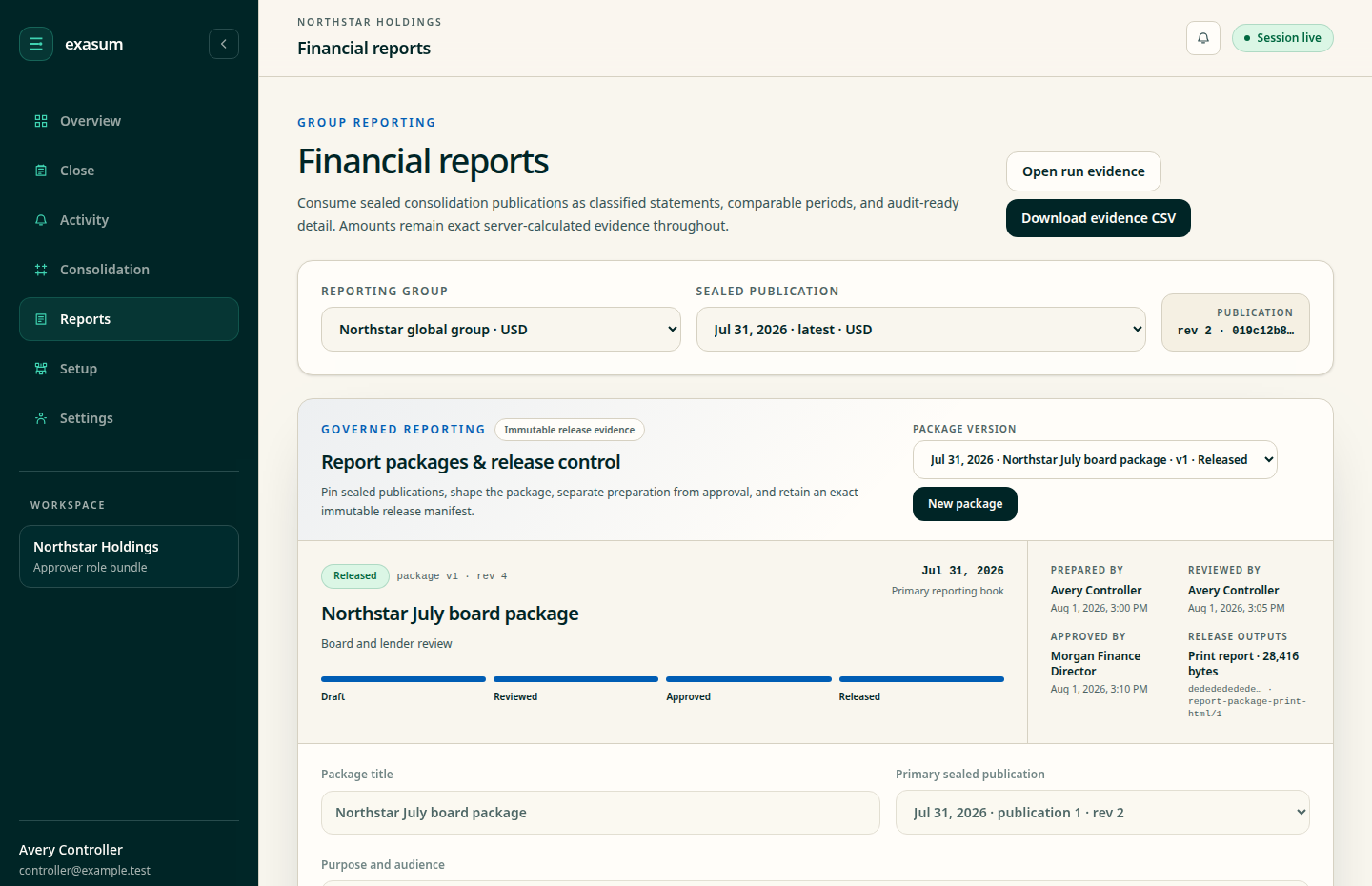
Read classified statements, open a result into its source path, and release a governed package with immutable manifest and print evidence.
The product
Exasum keeps scope, source facts, accounting meaning, decisions, exceptions, and release evidence on one versioned path.
See the worked product model01
Model direct legal owners once. Exasum derives effective interest through every valid path and freezes the period-specific scope used by consolidation.
02
Strict CSV and JSON contracts preserve source fidelity, validate a complete batch atomically, and identify semantic retries without duplicating evidence.
03
Publish entity and reporting charts with stable account identity, then make splits, dimensions, classifications, and coverage explicit in versioned mappings.
04
Select effective spot, average, and historical rates; retain exact conversion residuals; and apply full, proportional, or equity treatment with NCI evidence.
05
Evaluate reciprocal account pairs against dated rules and exact tolerances. Accepted entries are zero-sum; missing activity and excess variance stay named work.
06
Consume sealed publications as classified statements, comparisons, CSV evidence, drill-through lineage, and maker-checker report-package releases.
Technical confidence
Sealed source lineage, effective rules, deterministic decisions, and accountable actors preserve how a published figure came to be.
Explore the technical trust modelAvailability
A verified durable email can create a workspace for technical evaluation. The implemented product surface is broad; production operations, commercial commitments, and vendor adapters remain outside the current public claim.
Available in the preview
Outside the current claim
Questions
Direct answers about the implemented product boundary and the open preview.
Each entity can map source account and dimension values into a group reporting structure. Mapping versions are immutable and effective-dated, coverage is checked explicitly, and a consolidation fails closed when a required mapping is missing.
Exasum selects effective rates through explicit rules, applies each currency’s payable precision, preserves the chosen rate and conversion residual in publication lineage, and rejects a run when a required rate is unavailable.
Effective-dated elimination rules pair the relevant contributions. Matching is deterministic, accepted journals must sum to zero, and out-of-tolerance differences remain named discrepancies for review instead of being silently absorbed.
The implemented ingestion boundary accepts strict JSON and RFC-compatible CSV through the authenticated API. Vendor-specific accounting connectors and scheduled synchronization are planned adapters, not current product claims.
Imported periods can be submitted and independently approved before consolidation. Completed publications are immutable and retain their source rows, mappings, rates, eliminations, and actor audit; a later correction produces new evidence rather than rewriting an old result.
The current service uses Argon2id passwords, opaque hashed sessions, session-bound CSRF protection, encrypted TOTP, typed permissions, entity-scoped grants, PostgreSQL row-level security, and append-only audit records. Formal certifications are not claimed.
Start with real work
Create a blank open-preview workspace or walk through the entities, currencies, mappings, eliminations, and review controls that make your close difficult.