01
Mapping
Source and reporting accounts have stable identities. Effective mappings can split one contribution across explicit targets, but allocated amounts must conserve the exact source value.
- Coverage
- 100%
- Unmapped
- stop
Product
Exasum connects reporting scope, entity actuals, accounting configuration, approval, consolidation, exceptions, and governed reporting around one group and period.
Group-close workflow
Evidence advances through four controlled stages. Source identity, accounting meaning, decision lineage, and reviewer attribution stay attached throughout.
01
Publish the legal ownership graph, reporting entity, included members, consolidation methods, and reporting currency with an effective date.
02
Seal complete entity actuals, publish stable account identities, and resolve charts, mappings, dimensions, rates, and reciprocal elimination roots.
03
Pin each submission to one source snapshot, require separate approval, lock the period record, and recheck live authority and configuration before running.
04
Read classified results and exceptions from sealed evidence, inspect lineage, then approve and release a versioned report package.
Worked perimeter
NORTHSTAR GROUP
EFFECTIVE 2026-01-01
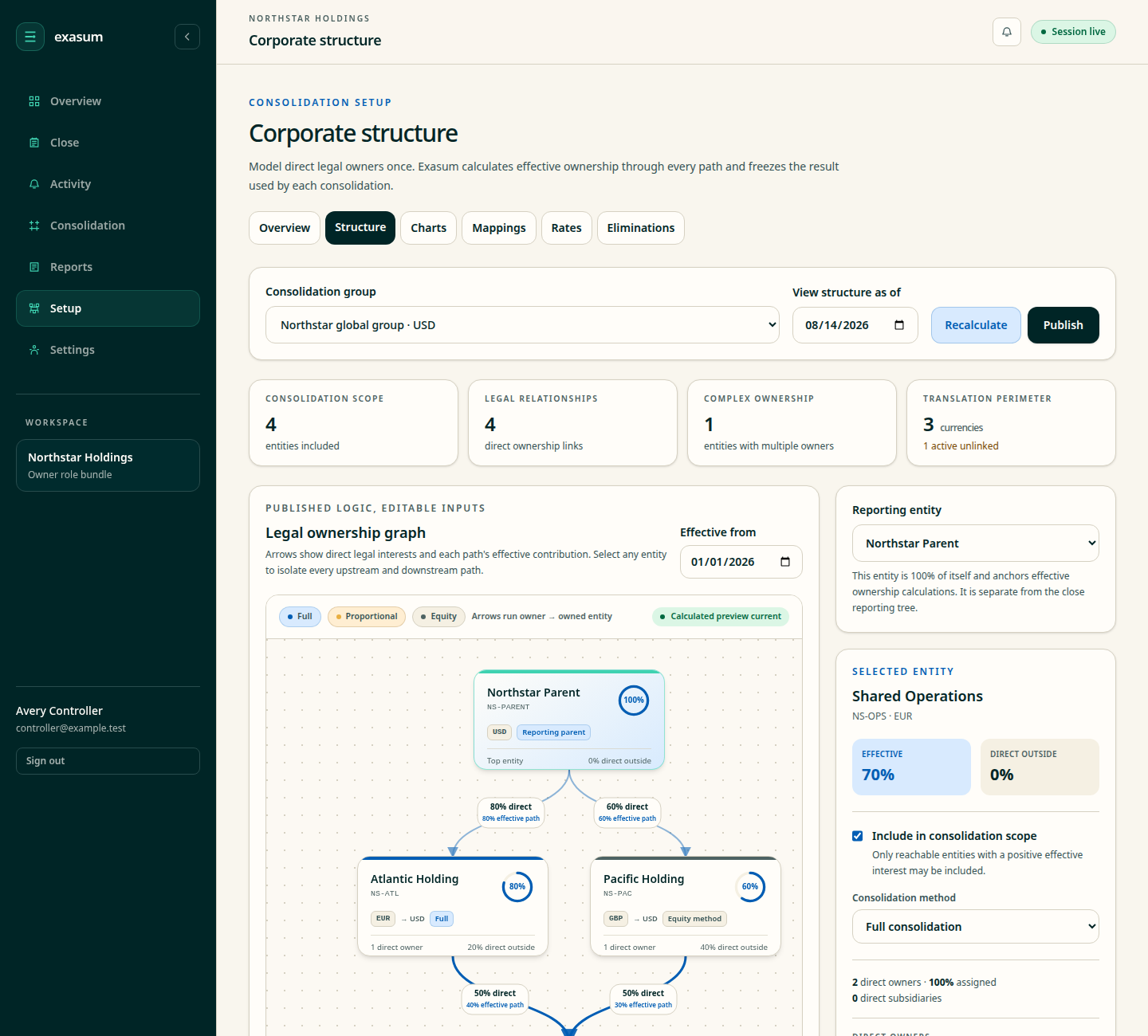
In this browser and domain vector, Northstar Parent reaches Shared Operations through two holdings. Direct legal interests are entered once; Exasum flows every path and owns the resulting effective percentage.
Effective ownership
80% × 50% = 40%
Northstar Parent → Atlantic Holding → Shared Operations
60% × 50% = 30%
Northstar Parent → Pacific Holding → Shared Operations
Owned outcome
70%
The two path contributions are added exactly, then sealed with the effective-dated scope used by the period.
Transformation evidence
The consolidation run consumes published account identity, exact rates, ownership outcomes, and reciprocal rules. Missing evidence is a blocker or named exception, never an invitation to guess.
01
Source and reporting accounts have stable identities. Effective mappings can split one contribution across explicit targets, but allocated amounts must conserve the exact source value.
02
Currency codes carry their payable precision. Rate selection is effective-dated, arithmetic is checked, and rounding is named at the currency boundary.
converted = half_even(source × rate) + residual03
Reciprocal signed contributions are compared symmetrically. Within tolerance, the journal is equal and opposite; otherwise the variance remains reviewable work.
Source
25,000.00
Counterparty
−24,992.50
Close and release
An entity submission pins one sealed actuals version. Returned work produces a later version; the preparer cannot approve their own submission or report package.
Release stores canonical manifest bytes and a self-contained print artifact with their lengths, SHA-256 digests, renderer versions, approval, release, activity, and audit evidence in the same transaction.
01
Sealed actuals, account identity, dimensions, submitter, and reviewer decision.
02
Approved entity snapshots plus exact group controls are locked into a manifest.
03
Mappings, rates, ownership, eliminations, NCI, classifications, and source paths are immutable.
04
Pinned publications, presentation policy, sections, artifact digest, approval, and release attribution.
Inspect the mechanisms